
How does ERW actually work?
Manage enhanced rock weathering deployments with rock sourcing logs, per-field application mapping, soil sampling schedules and lab-data capture built for CDR registries. Here's the field-to-credit process, and what's different about running it in India versus the global market.
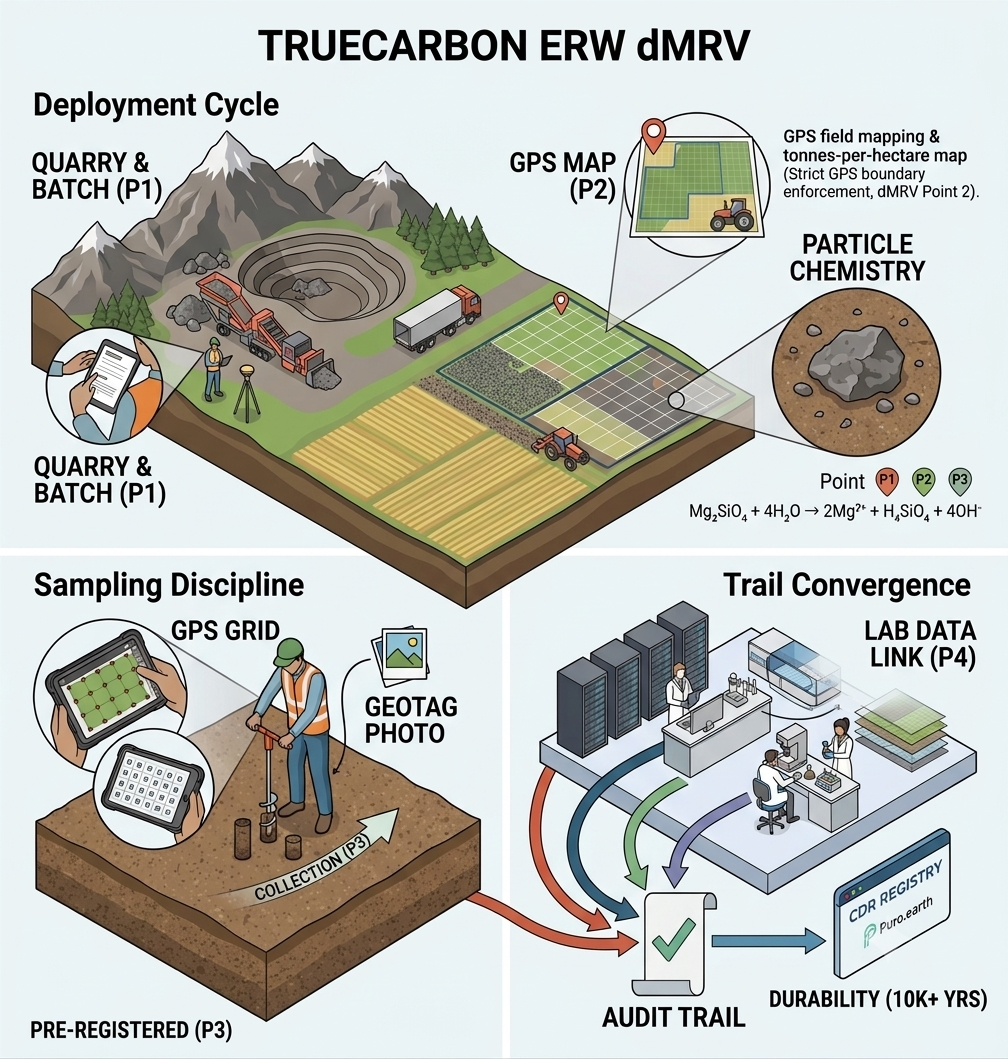
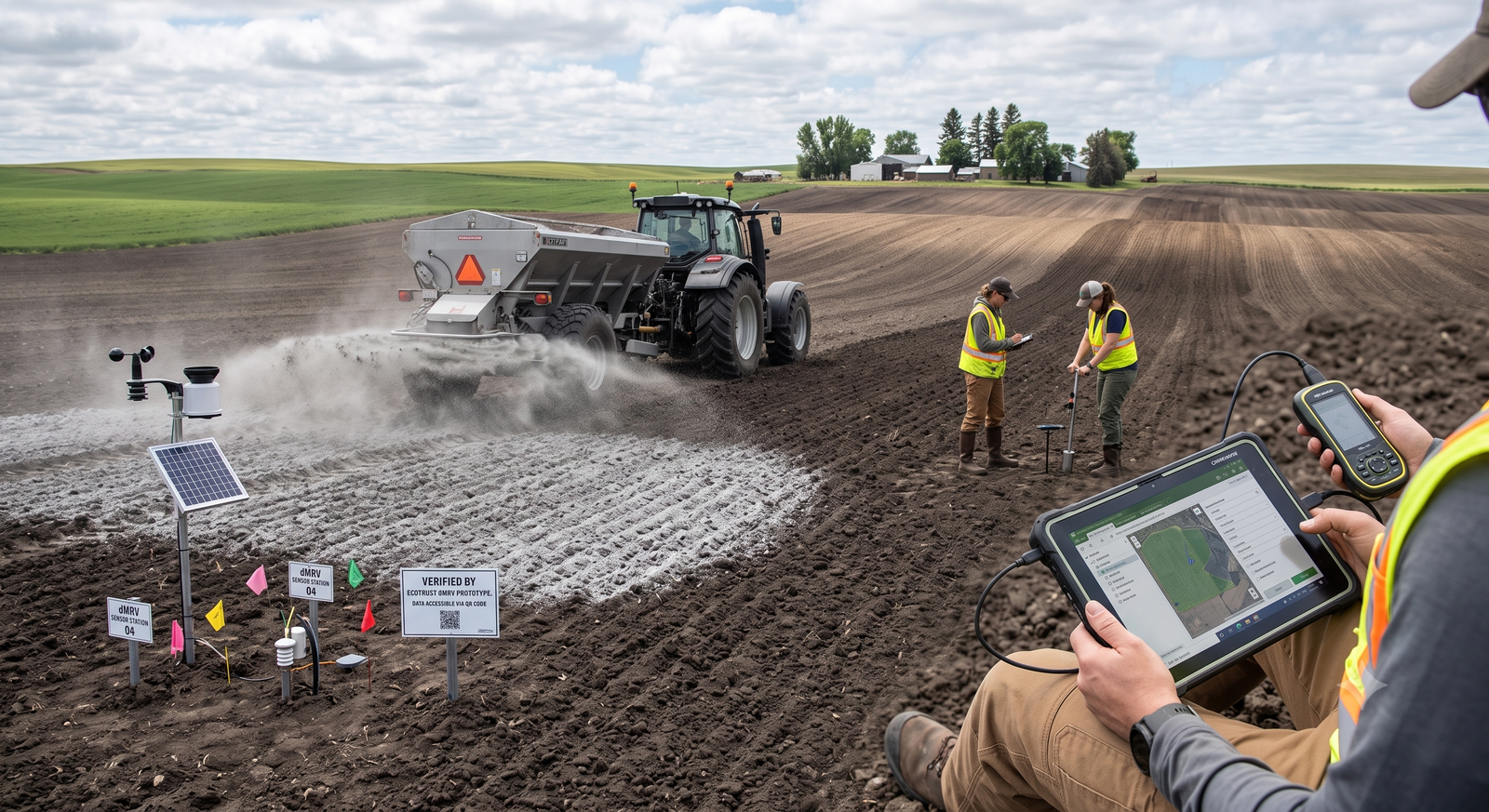

From rock weathering deployments to an issued credit
01
Source and grind rock
Basalt or similar silicate rock is quarried and ground to the particle size the methodology specifies.
02
Characterise mineralogy
Lab analysis confirms the rock's weathering potential and expected CO2 uptake per tonne applied.
03
Apply to fields
Ground rock is spread at a controlled application rate, mapped to precise field boundaries.
04
Sample soil at baseline and follow-up
Fixed sampling points are measured before and after application to track weathering progress.
05
Analyse weathering products
Lab results on cation concentrations and other markers quantify the CO2 actually removed, not just applied.
06
Verify and issue credits
Isometric, Puro.earth or an equivalent verifier checks sourcing, application and lab evidence before credits issue.
How erw works in India
India's Deccan Traps — one of the largest basalt formations on Earth, spanning Maharashtra, Madhya Pradesh, Gujarat and Karnataka — give it a genuine geological advantage for enhanced rock weathering.
The overlap between basalt availability and large agricultural areas in these states means rock-dust application could piggyback on existing farming operations rather than requiring new land.
ERW in India is still at pilot stage; most current activity is research and early demonstration rather than large verified credit volumes.
Co-benefits being explored alongside carbon include potential soil pH and micronutrient effects, which matter to farmer adoption independent of the carbon case.
Logistics — grinding capacity and transport of rock dust to fields at scale — is the practical constraint most often discussed, more than the underlying weathering science.
How erw works in the global market
Enhanced rock weathering is one of the more capital-intensive engineered-CDR pathways, attracting significant early-stage investment and long-term offtake commitments.
Isometric and Puro.earth are the leading methodology and verification bodies actively issuing ERW credits today.
Active geographies include the US, UK, Brazil and Malaysia, with interest expanding into India given basalt availability.
Advance market commitments from CDR-focused buyer coalitions have been a significant early demand driver, ahead of broad voluntary-market adoption.
Because the CO2 removal is measured indirectly, via soil chemistry over years, monitoring rigour and sampling consistency are the primary trust factors for buyers.
ERW — frequently asked questions
How ERW dMRV works with TrueCarbon, from data capture to verification.
Which ERW registries and protocols does TrueCarbon support?
The platform's configurable schema adapts to Puro.earth and Isometric protocol data requirements — sampling design, application records and lab-data linkage are all first-class objects.
Can TrueCarbon manage repeated soil sampling rounds over years?
Yes. Sampling points are permanent, so every campaign returns to the same coordinates and results accumulate into a defensible time series.
More on this methodology
How other programmes work
Ready to start
Running a ERW programme?
Talk to us about your programme's stage — whether you're mid-registration or just scoping the methodology.