
How to get carbon credits for ERW
A practical walkthrough of what it takes to earn verified carbon credits from rock weathering deployments — and where digital evidence makes or breaks the process.
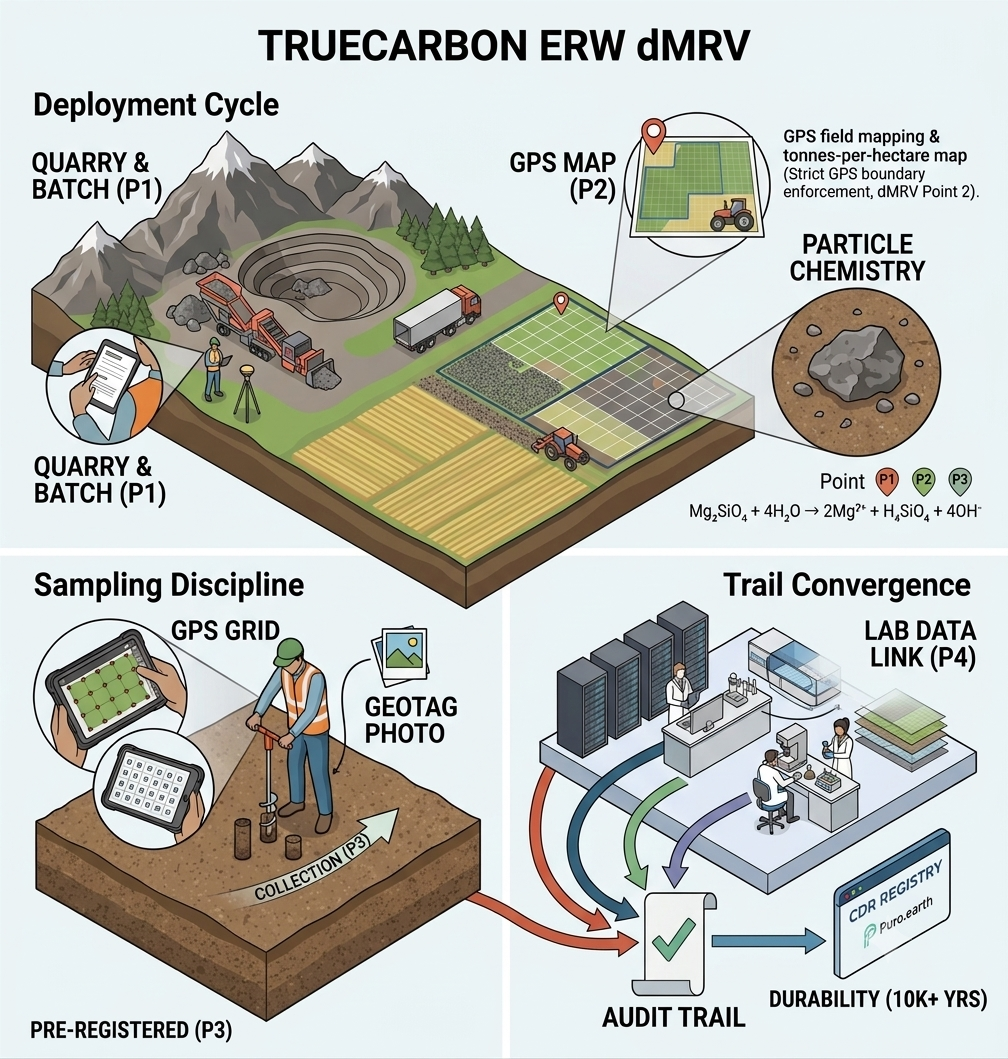

How the credit process flows for erw
01
Log rock sourcing
Quarry source, mineralogy reference, grind size and delivered tonnage recorded per batch.
02
Map field application
Application events tie tonnes-per-hectare to a precise GPS field boundary.
03
Run soil sampling campaigns
Pre-registered sampling points guide field teams; collection is logged with photo proof.
04
Link lab data and export
Geochemical results attach to the exact point and campaign, building the time series CDR registries require.
This is the same field-to-credit flow every methodology follows — see it explained in general terms on our impact page.
Why erw credits get delayed or discounted
Almost every delay traces back to one of these four evidence gaps.
Farm-level application data
Rock-dust application rates vary field to field, but records stop at the farm level — too coarse for a per-hectare claim.
Drifting sampling campaigns
Without field discipline, soil-sampling campaigns drift from their design and the time series loses its baseline.
Orphaned lab results
Geochemical results arrive as PDFs with no link back to the sampling point they came from.
Unprovable sampling rigour
Durable-CDR registries demand sampling rigour that paper processes simply can't evidence after the fact.
ERW carbon credits — FAQs
Key questions about generating and verifying ERW carbon credits.
Which ERW registries and protocols does TrueCarbon support?
The platform's configurable schema adapts to Puro.earth and Isometric protocol data requirements — sampling design, application records and lab-data linkage are all first-class objects.
Can TrueCarbon manage repeated soil sampling rounds over years?
Yes. Sampling points are permanent, so every campaign returns to the same coordinates and results accumulate into a defensible time series.
More on this methodology
Guides for other methodologies
Get started
Ready to start earning ERW credits?
Talk to us about your programme's stage — whether you're mid-registration or just scoping the methodology.