
How does Blue Carbon actually work?
Run blue carbon and mangrove restoration programmes with tidal-zone GPS boundaries, planting and survival tracking, and biomass sampling built for VM0033's coastal wetland requirements. Here's the field-to-credit process, and what's different about running it in India versus the global market.
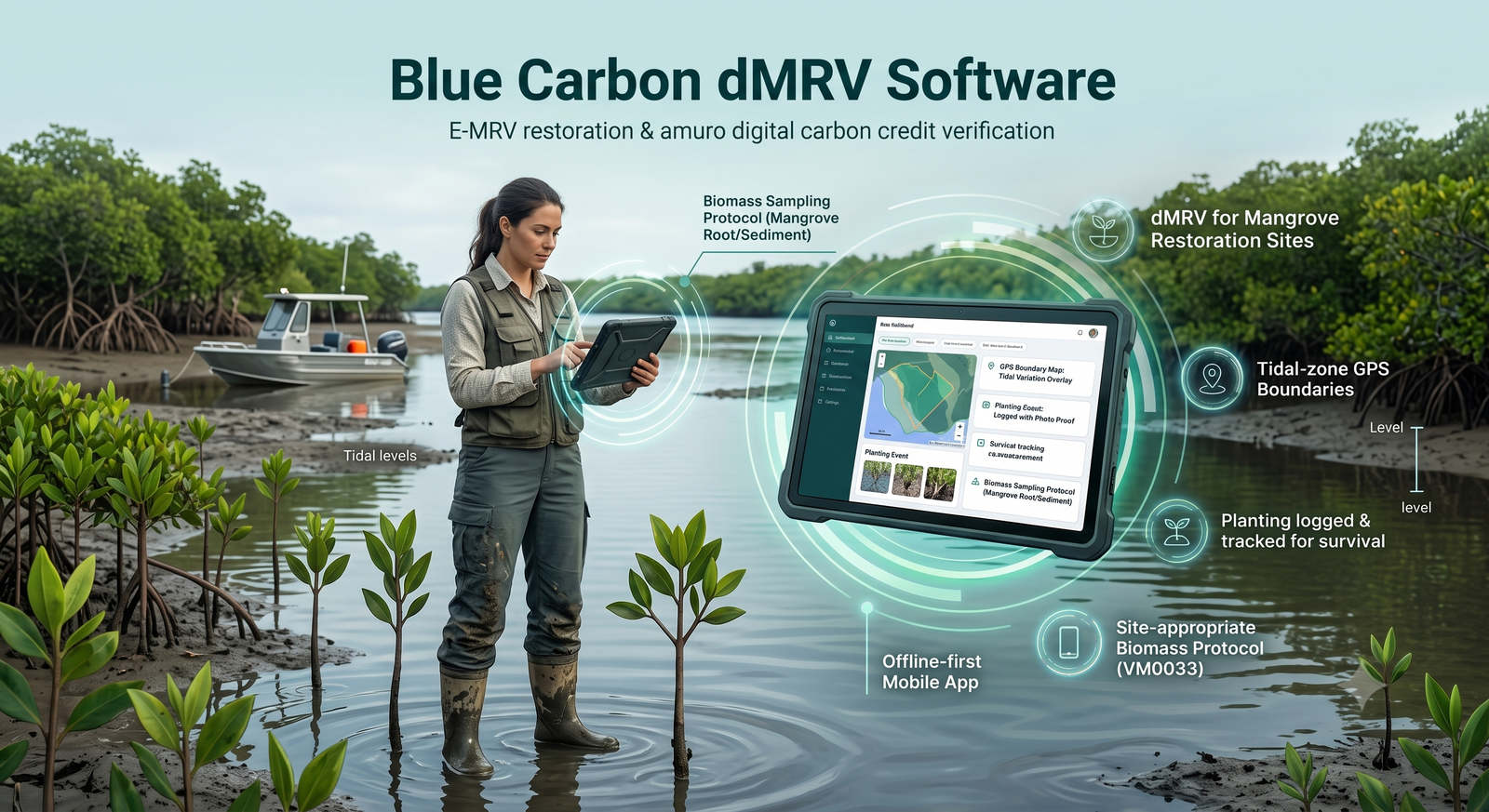
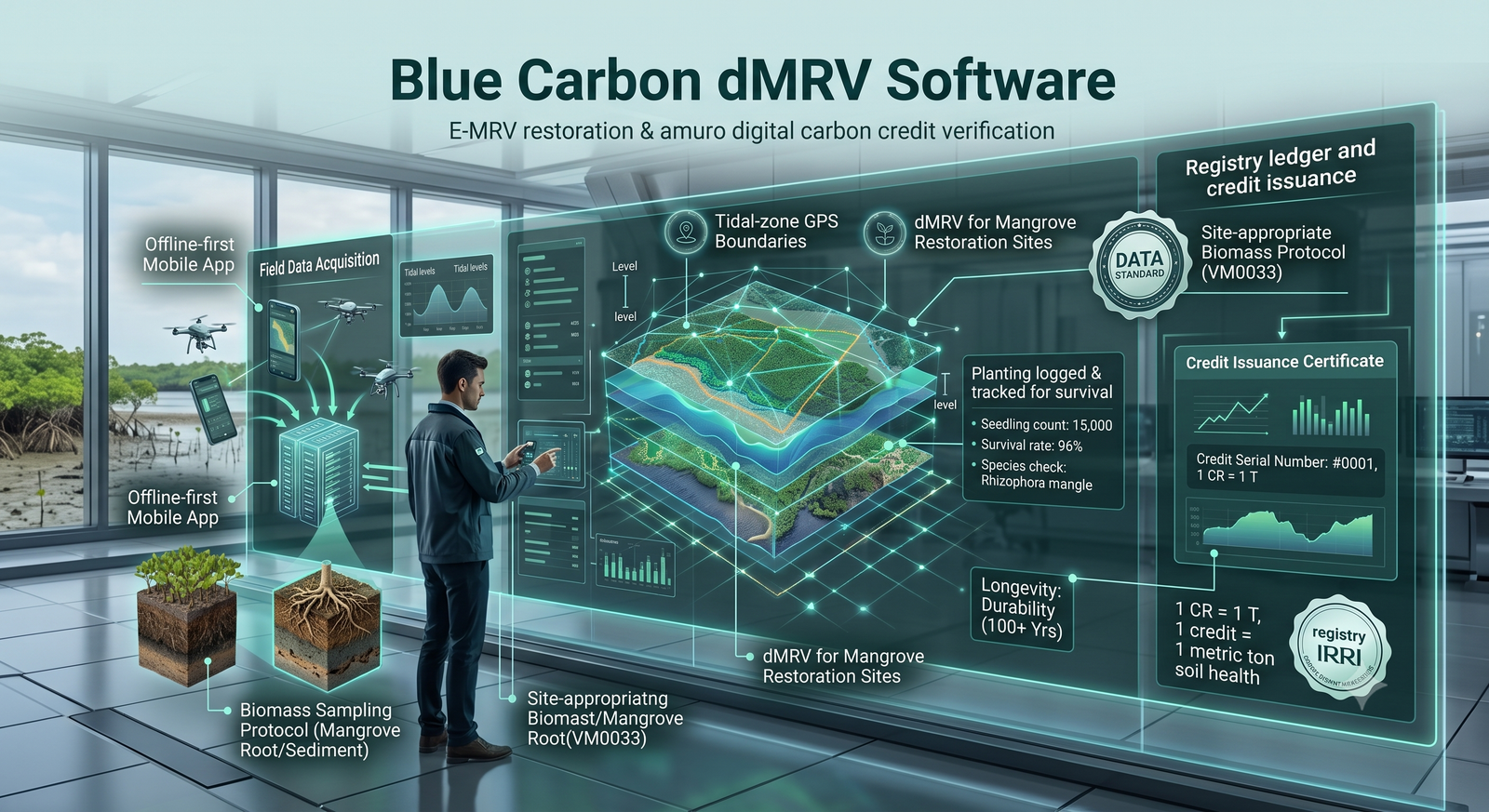
From mangrove restoration sites to an issued credit
01
Map the tidal-zone boundary
The restoration site's GPS boundary is registered accounting for tidal variation, not a single dry-season line.
02
Design the restoration
Species and planting design are chosen for the specific mangrove or wetland type and hydrology.
03
Plant and track survival
Planting events are logged and survival is re-measured on a schedule suited to saline, tidal conditions.
04
Sample biomass and sediment carbon
Site-appropriate protocols measure both above-ground biomass and below-ground sediment carbon, which mangrove systems store heavily.
05
Collect and sync data offline-first
Remote, boat-access-only sites capture data locally and sync once back in connectivity range.
06
Verify and issue credits
A verifier checks boundary, planting and sampling evidence before credits are issued under VM0033.
How blue carbon works in India
India has significant mangrove coastline — from the Sundarbans to Gujarat's Kutch coast and the Andhra Pradesh and Odisha deltas — and rising government attention on restoring it.
The national MISHTI initiative (Mangrove Initiative for Shoreline Habitats & Tangible Incomes) signals strong policy-level momentum for mangrove restoration specifically.
Voluntary-carbon-market blue carbon projects in India are still relatively nascent compared to government-led restoration, but interest is growing given the coastline's scale.
Coastal-protection and fisheries co-benefits are often as important to local community buy-in as the carbon case itself.
Boat-only access to many restoration sites makes offline-capable field data collection a practical necessity rather than a nice-to-have.
How blue carbon works in the global market
Blue carbon — mangroves, seagrass and salt marsh — is a high-value voluntary carbon market category due to strong sequestration rates and biodiversity/coastal-protection co-benefits.
Verra's VM0033 is the leading methodology for mangrove and coastal wetland restoration credits.
Indonesia, Colombia and Kenya, home to long-running projects like Mikoko Pamoja, are among the most established blue carbon geographies.
Buyers often value blue carbon credits partly for their strong co-benefit story — coastal protection and fisheries habitat — alongside the carbon tonnage.
Tidal and saline conditions mean survival-monitoring protocols validated for terrestrial ARR projects generally cannot be reused as-is for blue carbon.
Blue Carbon — frequently asked questions
How Blue Carbon dMRV works with TrueCarbon, from data capture to verification.
Does TrueCarbon support VM0033 for blue carbon projects?
The configurable field schema adapts to VM0033's coastal wetland data requirements — tidal-zone boundaries, mangrove-specific planting and survival tracking, and biomass sampling.
How does the platform handle remote, boat-access-only sites?
The mobile app is offline-first. Field teams collect data at the site regardless of connectivity and it syncs automatically once back in range.
How other programmes work
Ready to start
Running a Blue Carbon programme?
Talk to us about your programme's stage — whether you're mid-registration or just scoping the methodology.