
How does CBG actually work?
Digitise compressed biogas programmes — feedstock supply chains, digester operations, gas metering and dispatch — with records that stand up to registry scrutiny. Here's the field-to-credit process, and what's different about running it in India versus the global market.
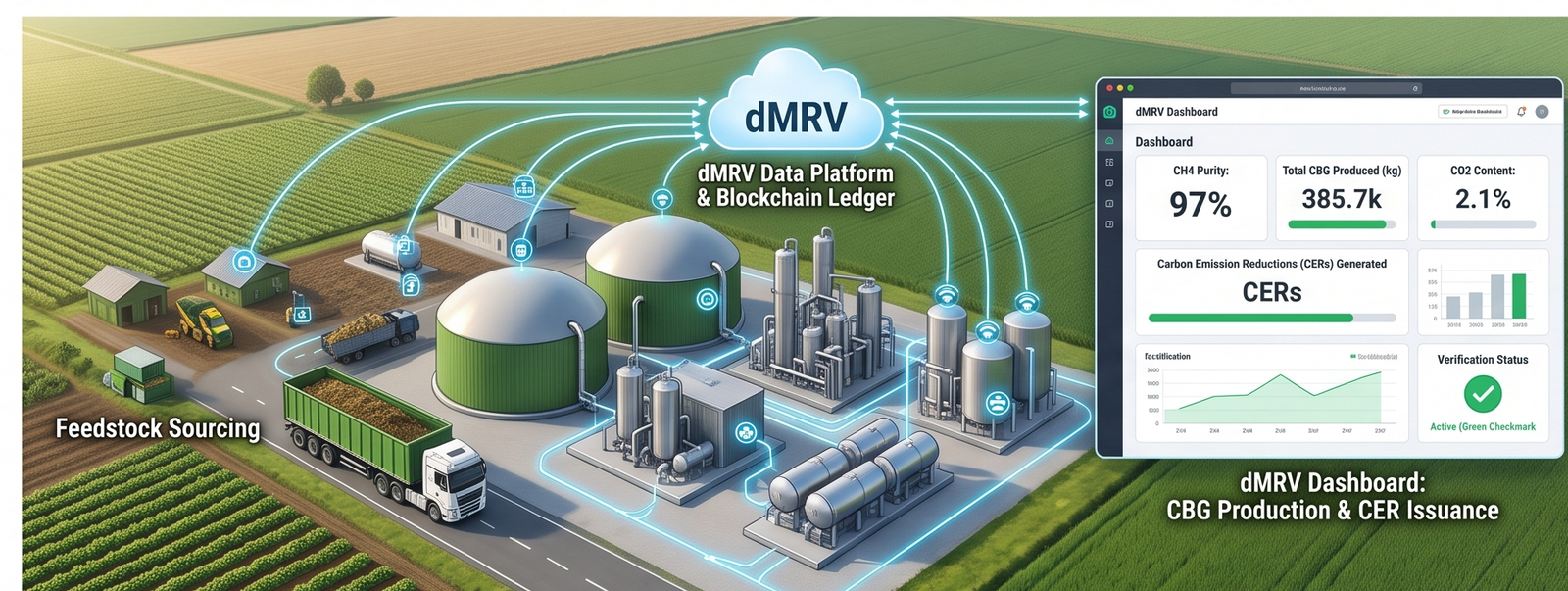


From biogas plants to an issued credit
01
Aggregate feedstock
Organic waste, agricultural residue or cattle dung is collected from suppliers and logged at the gate.
02
Run anaerobic digestion
Feedstock is digested to produce biogas, with plant operations logged daily.
03
Upgrade and compress gas
Raw biogas is purified and compressed into CBG for dispatch or use.
04
Meter output and dispatch
Gas produced and dispatched is metered and reconciled against feedstock intake.
05
Calculate avoided emissions
Reductions are calculated against a baseline of uncontrolled waste decay and/or displaced fossil fuel use.
06
Verify and issue credits
A verifier checks the feedstock, production and dispatch reconciliation before credits are issued.
How cbg works in India
CBG sits at the intersection of India's waste-management and energy-security priorities, which gives it policy support well beyond the voluntary carbon market alone.
The government's SATAT scheme (Ministry of Petroleum & Natural Gas) targets a large national rollout of CBG plants, with offtake agreements from Oil Marketing Companies alongside any carbon-credit revenue.
Feedstock is abundant given India's scale of agricultural residue, cattle dung and municipal organic waste — but reliably sourcing it from thousands of small suppliers is the operational challenge most projects actually face.
Many Indian CBG projects blend carbon-credit income with SATAT gas-offtake pricing and, in some cases, state biogas or waste-management subsidies — a different revenue stack from a pure-play carbon project.
Feedstock-supplier duplicate detection and delivery logging matter here specifically because supply chains often route through informal aggregators.
How cbg works in the global market
Biomethane/CBG projects trace back to CDM-era methodologies now carried into Verra's AMS-series equivalents, with biomethane playing a growing role in gas-grid decarbonisation.
Europe, notably Germany, has the most mature biomethane market, often integrated with gas-grid injection rather than compressed transport fuel.
Buyers include gas utilities and corporates decarbonising industrial heat or transport fleets, distinct from typical voluntary-offset buyers.
Baseline construction — what would have happened to the waste without the project — is the most scrutinised part of CBG methodologies worldwide.
Multi-site, multi-supplier programmes like India's are less common globally than single large-facility biomethane plants, making India's model somewhat distinct.
CBG — frequently asked questions
How CBG dMRV works with TrueCarbon, from data capture to verification.
Can TrueCarbon track feedstock from smallholder farmers to the CBG plant?
Yes. Farmers are registered as participants with duplicate detection, and every feedstock delivery is logged against a registered supplier with location and photo evidence.
Does the platform integrate with plant metering systems?
Metered readings can be logged through structured events today; direct meter/SCADA integration is on the roadmap. Talk to us about your plant's setup.
More on this methodology
How other programmes work
Ready to start
Running a CBG programme?
Talk to us about your programme's stage — whether you're mid-registration or just scoping the methodology.