
How to get carbon credits for Cookstoves
A practical walkthrough of what it takes to earn verified carbon credits from cookstove distribution programmes — and where digital evidence makes or breaks the process.
How the credit process flows for cookstoves
01
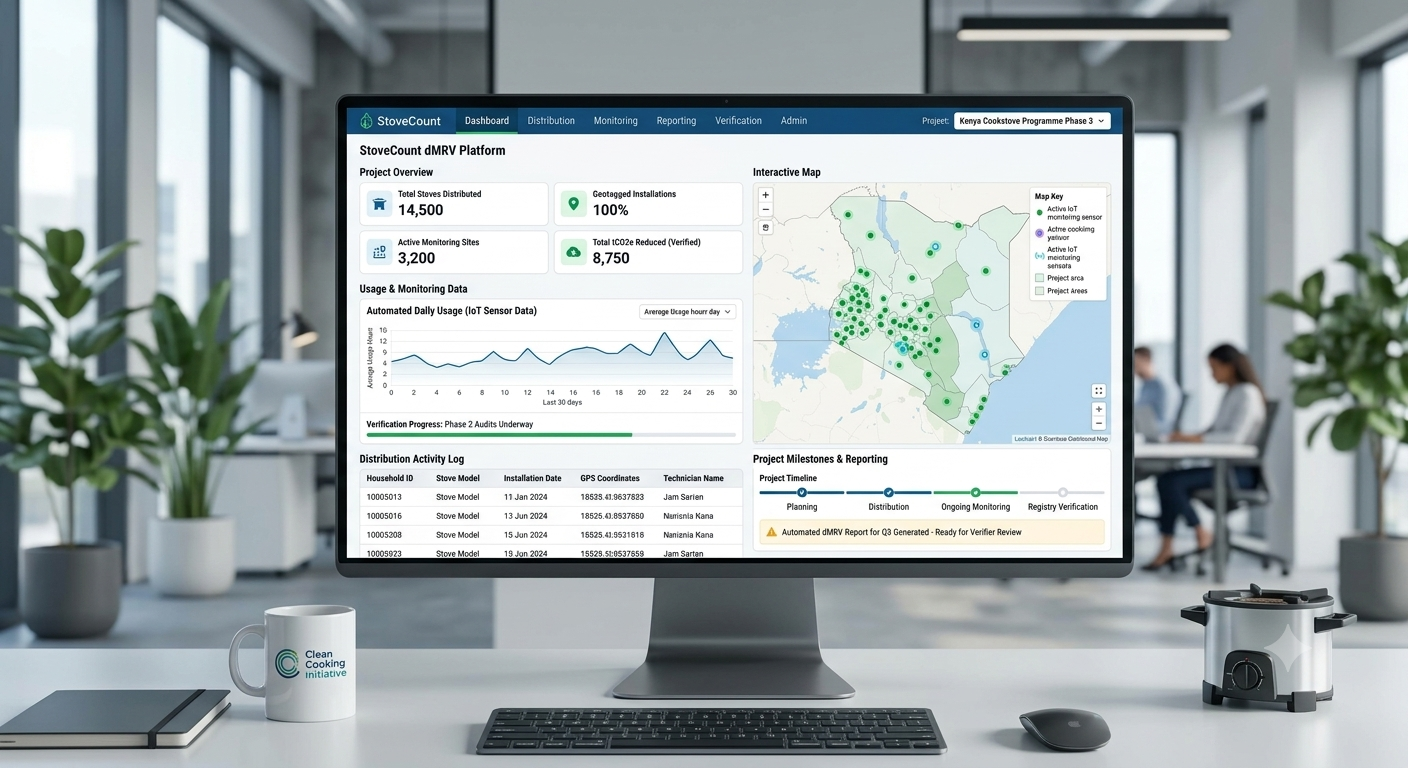
Enrol households
Register households with duplicate detection before a single stove goes out the door.
02
Distribute and serialise
Log each stove's serial number against its household, with photo evidence at handover.
03
Run usage surveys
Scheduled field visits capture usage-rate data across the monitoring period, not just at baseline.
04
Check durability and export
Confirm continued use, then export a monitoring report mapped to your AMS-II.G data requirements.
This is the same field-to-credit flow every methodology follows — see it explained in general terms on our impact page.
Why cookstoves credits get delayed or discounted
Almost every delay traces back to one of these four evidence gaps.
Double-counted households
Households get enrolled again across distribution rounds, quietly inflating the distribution count credits rest on.
Untracked stove serials
No record ties a stove's serial number to the household that received it, so distribution can't be independently checked.
Estimated usage rates
Usage-rate claims lean on a one-off estimate instead of repeated field surveys — exactly what registries now scrutinise.
Skipped durability checks
Continued-use and durability checks lapse after year one, leaving later crediting periods without evidence.
Cookstoves carbon credits — FAQs
Key questions about generating and verifying Cookstoves carbon credits.
Does TrueCarbon support AMS-II.G monitoring requirements?
The configurable field schema captures household enrolment, stove serials, usage surveys and durability checks — the data points AMS-II.G monitoring plans typically require.
Can we track multiple stove models or distribution partners?
Yes. Stove models, distribution partners and programme rounds are all configurable fields, so one platform covers a multi-partner rollout.
Guides for other methodologies
Get started
Ready to start earning Cookstoves credits?
Talk to us about your programme's stage — whether you're mid-registration or just scoping the methodology.